Meeting on Applied Algebraic Geometry 2026
April 18–19, 2026 · Clemson University
Overview
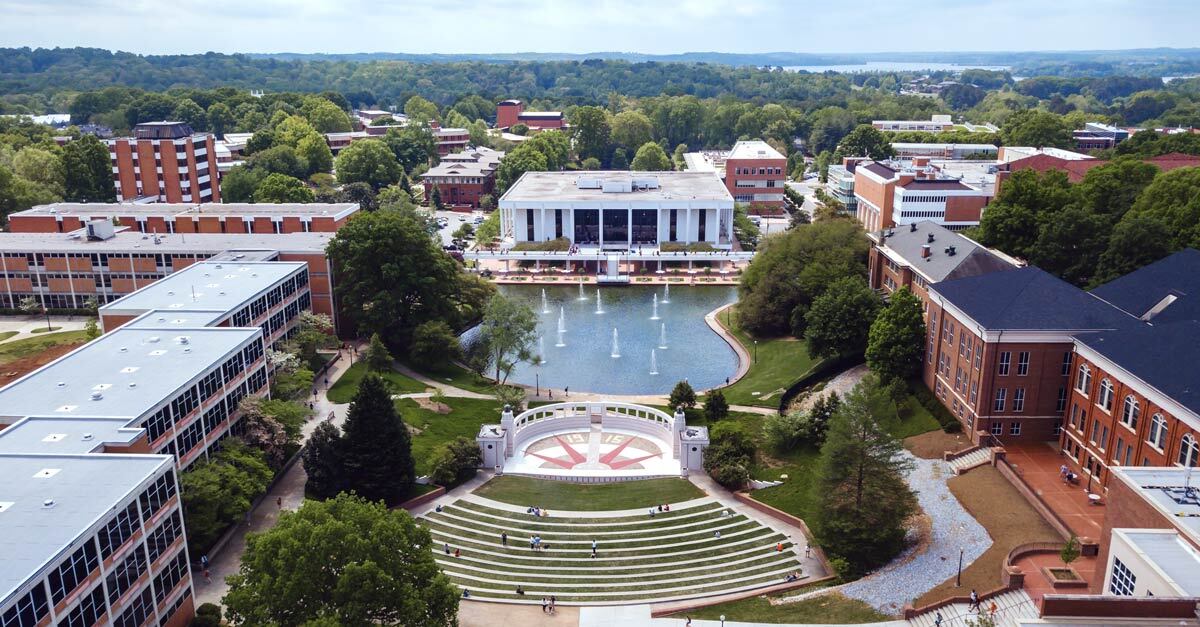
The Meeting on Applied Algebraic Geometry (MAAG) is a regional gathering that attracts participants primarily from the Southeastern United States. MAAG 2026 takes place at Clemson University on April 18-19, 2026. Previous meetings were held at Georgia Tech in 2015, 2018, 2019, and 2023; at Clemson in 2016; and at Auburn in 2025.
Organizers: Michael Burr, John Cobb, Kisun Lee, Anton Leykin, Julia Lindberg, Luke Oeding
For any inquiries regarding the meeting, please contact kisunl@clemson.edu.
Talks
-
Yulia Alexandr (University of California, Los Angeles)
Algebraic invariants in machine learningAbstract
This talk explores how algebraic geometry offers powerful tools for understanding machine learning models. I will explain how the algebraic and semi-algebraic structure of modern models (ReLU, polynomial, and self-attention) gives rise to polynomial invariants and complexity measures, such as Euclidean distance degree. These tools provide theoretical guarantees for neural network verification, optimization, and robustness, supporting safety-critical applications.
-
Ayah Almousa (University of Kentucky)
Computing with positroid varieties via Gröbner basesAbstract
Positroid varieties are subvarieties of the Grassmannian defined by the vanishing of selected Plücker coordinates determined by a matroid. In joint work with Daoji Huang and Shiliang Gao, we study their defining ideals from a computational perspective. We prove that these ideals admit Gröbner bases with respect to natural term orders and describe the resulting initial ideals explicitly. These Gröbner degenerations allow explicit computation of invariants such as Hilbert series and provide tractable models for further geometric study.
-
Julianne Barnhart (Clemson University)
Restricted monodromy groups and applications to sparse polynomial systemsAbstract
The monodromy group of a branched cover $\pi:X\to Y$ is a permutation group resulting from taking loops in the base space $Y$, as the lift of each loop induces a permutation of points in a fibre. We consider restricting $\pi$ to some generic subvariety $V$ of $Y$, with $X_V$ the preimage of $V$ under $\pi$. When $X_V \to V$ is a branched cover, we prove relationships between the monodromy group of the full branched cover and the monodromy group of the restricted branched cover. The existence of a transposition in the restricted monodromy group guarantees that the restricted monodromy group and the full monodromy group share a unique minimal block structure. As a consequence, we give conditions for the restricted monodromy group to be the full symmetric group. Additionally, we discuss applications of restricted monodromy groups in various settings in applied algebraic geometry including sparse polynomial systems and computer vision.
-
Alex Dunbar (Georgia Tech)
Applications of duality for quadratic inequalitiesAbstract
Systems of (affine) linear inequalities have a well-known duality theory that is a fundamental tool in pure and applied mathematics. Systems of quadratic inequalities also have a duality theory, though it is less well-known. Specifically, the homology of a set defined by a system of quadratic inequalities is related to the topology of (the complement of) a real algebraic hypersurface, which serves as a dual object to the given system. In this talk, we discuss applications of this framework to problems in applied mathematics. A key example will be the description of convex hulls of sets defined by three quadratic inequalities.
-
Emily King (Colorado State University)
Group actions in frame theory, quantum information theory, and machine learningAbstract
Group actions may be leveraged to create subspace configurations which are optimal in frame theory and quantum information theory, with equiangular Fourier frames and symmetric, informationally complete, positive operator-valued measures (SIC-POVMs) being two of the most well-known examples. In machine learning, highly symmetric vectors emerge when training neural networks under certain regimes (neural collapse), while orbits of group actions may be leveraged to perform classification tasks (e.g., bilipschitz invariants, group-invariant max filtering, invariant/equivariant neural networks). This talk will introduce these applications and conclude with some open problems.
-
Christopher Manon (University of Kentucky)
Khovanskii bases and Cox ringsAbstract
Khovanskii basis is a set of elements that generate both an algebra and one of its associated graded algebras. Khovanskii bases are instrumental in solving various problems, from computing Newton-Okounkov bodies to modeling applied systems like chemical reaction networks and coupled oscillators. I'll give an overview of the theory of Khovanskii bases and then describe a recent application to the problem of computing the Cox ring of a variety. In particular, I will focus on computing Cox rings from the class of projectivized toric vector bundles. In this setting, the Khovanskii basis algorithm interacts in interesting ways with the theory of matroids.
-
Kalina Mincheva (Tulane University)
Integral elements and normalization in tropical geometryAbstract
This work is part of a broader program to develop necessary commutative algebra tools for the semirings arising from tropicalization. We will discuss different notions of integrality which while equivalent for rings are not for idempotent semirings. We will define integral closure and give different characterizations. If time permits we will give some examples of normalization in tropical geometry.
-
Ezra Nance (The University of Tennessee at Martin)
Slicing the cone of positive polynomialsAbstract
Parametrizing sets is often a good way to gain understanding about them. In this talk, we focus on the cone of all univariate non-negative polynomials over a closed interval. This set is connected to the theory of moment problems, which have several applications. Throughout the talk we develop a parametrization of this cone which naturally partitions it into several high-dimensional polyhedral cones, each polyhedral cone being easier to understand than the entire set itself. This is a joint work with Hoon Hong.
Poster Presentations
- Ryan Anderson (University of California, Los Angeles) - A quantifier-free description of the semi-algebraic set of value functions in partially observable Markov decision processes
- Cheng Chen (University of Wisconsin, Madison) - Algebraic characterization of reliability phase transitions in infinite-depth supply networks
- Aviva Englander (University of Wisconsin, Madison) - The Allee effect: A case study in numerical methods
- Rickey Huang (Georgia Tech) - Approximating periodic orbits with algebraic curves and related minimal problems
- Kisun Lee (Clemson University) - CertifiedHomotopyTracking.jl
- Jingyi Long (Georgia Tech) - Algorithms for rational univariate representation and geometric resolution
Macaulay2 Mini-Workshop
- Kisun Lee (Clemson University) - Complex interval arithmetic implementation in Macaulay2
- Jose Israel Rodriguez (University of Wisconsin, Madison) - TDA
- Douglas Torrance (Piedmont University) - What's new in the next Macaulay2 release
Schedule
All talks in Martin Hall M102.
| Time | Session |
|---|---|
| 16:30–18:00 | Mini Macaulay2 event (Martin M101) |
| 18:30- | Dinner (Your Pie Pizza - Clemson Downtown) |
| Time | Session |
|---|---|
| 08:30–09:00 | Registration + Coffee (Martin M101) |
| 09:00–09:50 | Talk 1 — Ezra Nance |
| 10:00–10:50 | Talk 2 — Alex Dunbar |
| 10:50–11:10 | Break |
| 11:10–12:00 | Talk 3 — Ayah Almousa |
| 12:00–12:20 | Poster Blitz |
| 12:20–13:00 | Lunch (Martin M101) |
| 13:00–14:00 | Poster Session (Martin M101) |
| 14:00–14:50 | Talk 4 — Yulia Alexandr |
| 14:50–16:00 | Coffee Break / Poster Session (Martin M101) |
| 16:00–16:50 | Talk 5 — Emily King |
| 18:00– | Dinner (Red Bowl Asian Bistro) |
| Time | Session |
|---|---|
| 08:30–09:00 | Coffee (Martin M101) |
| 09:00–09:50 | Talk 6 — Kalina Mincheva |
| 10:00–10:20 | Break |
| 10:20–11:10 | Talk 7 — Julianne Barnhart |
| 11:20–12:10 | Talk 8 — Christopher Manon |
| 12:10–13:10 | Lunch (Martin M101) |
| 13:30- | M2 mini-workshop |
| 13:30–14:15 | ├ Doug Torrance |
| 14:15–15:00 | ├ Jose Israel Rodriguez |
| 15:00–15:15 | ├ Break |
| 15:15–16:00 | └ Kisun Lee |
Participant Information
Lodging
We will be housing all supported participants at the Comfort Inn & Suites Clemson - University Area. Self free parking available.
Travel
Fly to Greenville-Spartanburg International Airport(GSP). Shuttle option available upon request. Renting a car and Uber are available in the area.
Local
- Parking: E-6 parking
Weekend Visitor Permits needed (link) - Lunch: catered (Sat/Sun)
- Dinner: 6:00 PM (Sat) at Red Bowl Asian Bistro
Policies
We are required by the NSF Proposal & Award Policies & Procedures Guide (Chapter II.E.7), effective February 25, 2019, to provide all event participants with information on the University’s policy on sexual and other forms of harassment or sexual assault as well as directions on how to report any violations of this policy. For purposes of this requirement, “other forms of harassment” is defined as “non-gender or non-sex-based harassment of individuals protected under federal civil rights laws, as set forth in organizational policies or codes of conduct, statutes, regulations, or executive orders.”
We are committed to a respectful and inclusive meeting environment. MAAG 2026 follows Clemson University's policies on harassment and discrimination. Detailed conduct guidelines and Title IX resources will be provided to all participants.Funding
This conference is supported all or in part by the National Science Foundation under DMS Award No. 2552457.
To be considered for travel support, please register by March 15, 2026. Students and early career mathematicians are strongly encouraged to present a poster; priority for travel funding will be given to poster presenters.

Register
Registration closed. For registration information, please contact kisunl@clemson.edu.